
Press Release Distribution in India: how a release reaches the right desk
A press release only works if a journalist opens it, believes it and finds a reason to use it today. We write releases for Indian newsrooms and send them the right way for the story: through a wire service, by pitching reporters one to one, or both in a planned order.
- Written for the desk, not a blast list
- English, Hindi, Marathi and Gujarati releases
- A written report of every story and pick-up
By the TTS Digital PR team · Updated
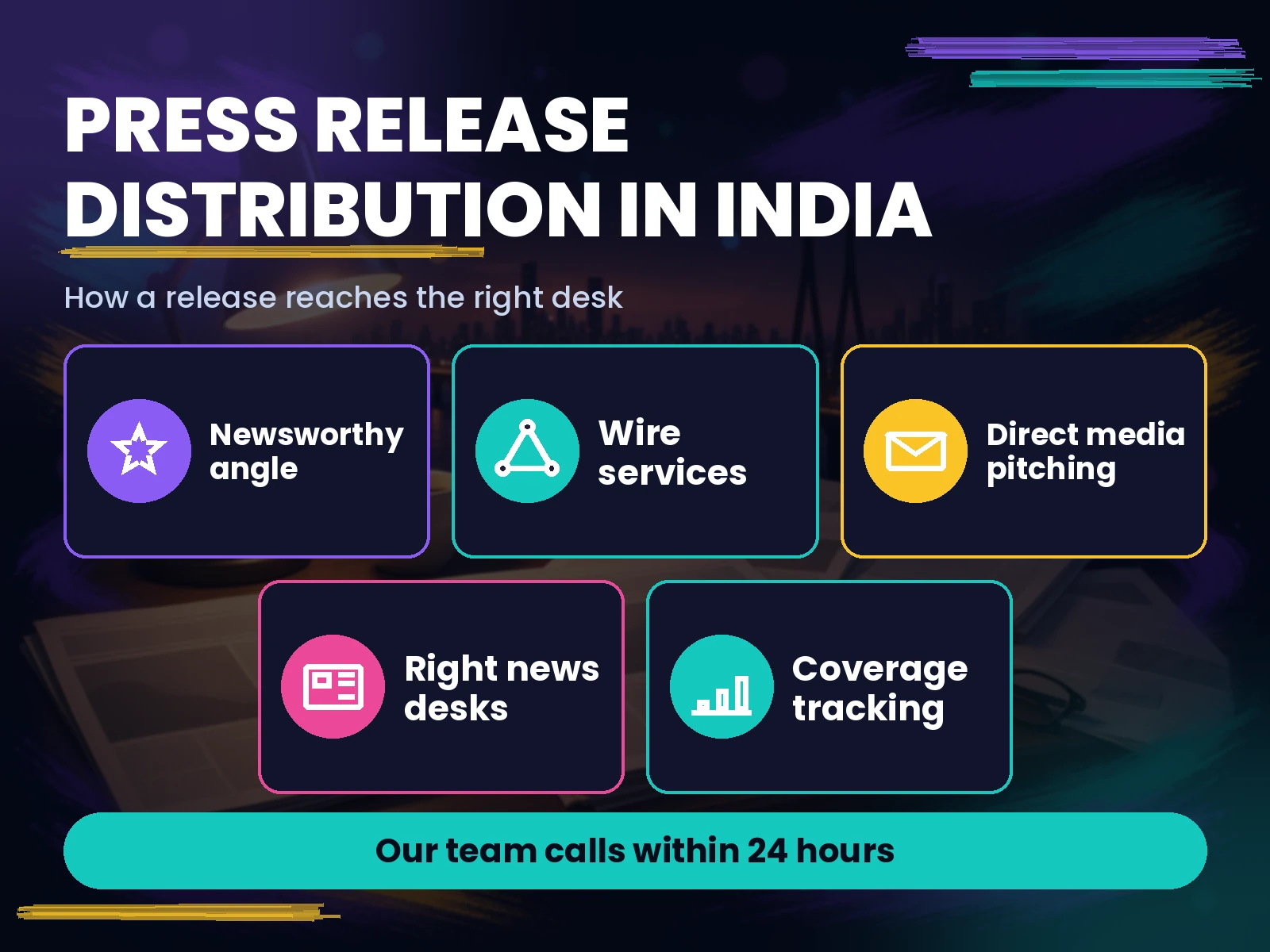
What press release distribution in India really means
Distribution is the part of PR most people think they understand: you write a release, send it to "the media" and wait. In India that picture leaves out how newsrooms actually work. A national business desk, a city page in Pune, a Marathi daily and a trade magazine each receive a steady stream of releases, and each decides in seconds whether one is worth a second look.
There are two main routes. A wire service carries your release to subscribing newsrooms and news websites, where it may be used as it is, rewritten or ignored. Direct pitching means a person who knows the desk sends your story to the reporter who covers that beat, with a short note on why it matters to their readers. Releases that earn real stories usually rely on direct pitching, sometimes followed by a wire release for a wider public record.
Good distribution starts before the send: a real piece of news, a headline that says it plainly, facts a reporter can check and a spokesperson who answers the phone. This page explains how each route works, when to use which, and the checks we run before any release leaves our desk.

Have a release ready? Let us read it first.
Send us the draft or just the news. Our team calls you back within 24 hours, tells you honestly whether it is news, and sends a written scope.
How press release distribution works, step by step
Five steps, the same for a city update or a national announcement.
Check the news
We ask what is new, who it matters to and why today. If it is not news yet, we say so before anything is written.
Write for the desk
One release in plain language, plus short versions for the reporters who prefer a two-line pitch.
Choose the route
Direct pitching, a wire release, or both in order, decided by the story and where your readers are.
Send and follow up
Personal pitches first, one polite follow-up, and the spokesperson free for calls on the day.
Monitor and report
Every story, interview and link collected, pick-ups listed separately, with notes on which desks responded.

Wire service vs direct pitching vs both
Each route reaches desks in a different way. The story decides which one we use.
| Wire service | Direct pitching to journalists | Both, in a planned order | |
|---|---|---|---|
| How it reaches the desk | Through a feed that newsrooms and news sites subscribe to | A personal note to the reporter who covers the beat | Pitches first, then the wire for the wider record |
| What usually happens to it | Used as it is, rewritten, or not used | Read by one person, who may call with questions | Stories from the pitches, plus pick-ups from the wire |
| Best for | Formal announcements that need a public record | Stories a reporter has to understand | Big announcements with several angles |
| Control over timing | An exact release time | Depends on each reporter, or an agreed embargo | Embargo for the pitches, a set time for the wire |
| What you get back | A list of sites and feeds that carried it | Interviews, quotes and original stories | Both, in one report |
| Watch out for | Pick-up counts that are mostly automatic copies | Pitching too many reporters at once | Sending the wire before pitched reporters publish |
Press release services, from first draft to final report
Use one for a single announcement, or all of them for a launch.
Press release writing
A headline, a first paragraph that answers who, what, where and why, one real quote and the facts a reporter needs.
Media lists by beat
Reporters chosen for the story: business, city, technology, health, property or trade, never one list for everything.
Direct pitching
Short, personal notes to the right reporters, followed up by phone, with the spokesperson ready for calls.
Wire distribution, where it fits
A wire release for announcements that need a wide public record, sent after or alongside the direct pitches.
Regional language releases
Hindi, Marathi and Gujarati versions written for those readers, not translated word for word.
Press kits and photos
Fact sheet, background, clean photos and spokesperson profiles in one link, ready for any desk that asks.
What makes a desk pick up a release: 6 signs
Reporters look for the same things in every newsroom, usually in the first few lines.
Real news in the headline
A plain headline that says what happened. If the news is only in the fourth paragraph, the reporter never gets there.
A reason to care today
Why it matters to this desk's readers now: a change in their city, their industry or their daily life.
Facts they can check
Dates, places, sourced numbers and names spelt correctly. One wrong fact and the release is set aside.
A quote worth using
One sentence a person would actually say, with a view or a detail, not "we are delighted to announce".
Someone who answers
A named media contact and a spokesperson who pick up the phone on the day and reply to emails within hours.
Pictures that are ready
Clean, captioned photos the desk can use without asking, sized for print and for the web.
Is your press release ready to send?
Tick what is true of your release. It works on any release, written by anyone. Your answers stay on your screen; nothing is sent or saved.
A Hindi pitch note for a press release, line by line
Hindi desks often prefer a short personal note, with the release itself written in Hindi rather than translated. This is the shape of that note; we write each one fresh for the story.
- विषय
मुंबई की [कंपनी] अब [शहर] में भी: [एक वाक्य में ख़बर]
The subject line is the news, in the desk's language. - नमस्ते
नमस्ते [रिपोर्टर का नाम] जी, [विषय] पर आपकी हाल की ख़बर पढ़ी।
A named reporter, and proof you follow their beat. - ख़बर
[तारीख़] को [कंपनी] ने [क्या किया], जिसका असर [किन पाठकों] पर होगा।
One sentence: what happened and who it affects. - सामग्री
हिंदी में पूरी प्रेस विज्ञप्ति और दो तस्वीरें इस लिंक पर हैं।
A link, not heavy attachments. - बातचीत
[प्रवक्ता का नाम] आज और कल फ़ोन पर बात करने के लिए उपलब्ध हैं।
Offer a person and a time, so the reporter can act. - अंत
अगर यह आपके पन्ने के लिए सही नहीं है, तो बस बता दीजिए; हम दोबारा परेशान नहीं करेंगे।
Reporters remember who respected their time.
Press release checklist: 8 checks before we send
We run these on every release. Use them on any release, from any agency, including ours.
- The news is in the headlineA reader should know what happened from the headline alone.
- The first paragraph stands aloneWho, what, where, when and why, in two or three sentences.
- Every fact confirmedDates, names, places and figures checked with you in writing.
- Claims that can be provedNo "first", "largest" or "leading" without a named source.
- One real quoteA view or a detail from a named person, approved by them.
- The right listReporters chosen for this story, with the reason noted for each desk.
- Embargo terms clearIf there is an embargo, its date and time are on the first line.
- Contact and photos readyA named contact, a working phone number and captioned photos cleared for use.
Who reads a press release in Indian newsrooms
A release sent in India can land on several kinds of desks: national business and general news desks, city pages, regional language papers, trade magazines for a single industry, news websites, television planning desks and newsletter writers. Each is staffed by people with a beat and a deadline, and each wants the story told for its own readers.
That is why one release rarely fits all of them. A business desk wants the numbers and what they mean for the sector; a city page wants the local impact; a Hindi or Marathi paper wants it in its own language, with its readers' interests first; a trade magazine wants the technical detail. We write the core release once and shape the pitch for each desk.

Press release distribution mistakes to avoid
These are the reasons most releases are never read.
Sending one release to a list of thousands of addresses
Mass mail looks like spam to reporters, and the right ones never notice it.
Counting automatic copies on websites as coverage
Copies on sites nobody reads look good in a report but rarely reach your customers.
Attaching heavy files instead of a link or a small photo
Large attachments get blocked or ignored. A link and one small photo are enough.
A headline full of adjectives and no news
"Leading", "innovative" and "revolutionary" tell a reporter nothing. Facts do.
No one available to answer calls on the day
A reporter with a question and no answer moves on to the next story.
Press Release Distribution in India: questions
Is a wire service enough to get coverage in India?
Sometimes, for formal announcements that need a public record. For stories a reporter has to understand, direct pitching to the right journalists works better, and many releases use both.
What is the difference between pick-ups and coverage?
A pick-up is a website or feed carrying your release as it is, often automatically. Coverage is a reporter choosing to write about you, interview your spokesperson or quote you. We report the two separately.
How many journalists should a release go to?
Everyone who covers the beat and would care, which is usually a focused list for each desk rather than thousands of addresses. The story decides the list.
Can you send our release in Hindi, Marathi or Gujarati?
Yes. We write separate versions for regional language desks, shaped for those readers, rather than translating the English word for word.
What day and time is best to send a press release?
Early on a working day suits most desks, away from big scheduled news. For a national release we also check the news calendar so it is not lost behind a budget or a results day.
Should we put our release under embargo?
An embargo helps when reporters need time to prepare, such as a launch or a report with new data. It only works with reporters who have agreed to it, so we confirm terms before sharing anything.
Will every journalist who receives it publish it?
No. Editors decide what they publish, and no agency can promise that. A clear story sent to the right desks makes coverage far more likely.
What do we get after distribution?
A written report with every story, interview and link, the pick-ups listed separately, and notes on which desks responded and why.
Do you handle releases for companies outside Mumbai?
Yes. We plan from Mumbai and pitch national, city and regional desks across India, in the languages your readers use.
Related PR guides from TTS Digital
Pages that go deeper on the work around a release.
Best PR agency in Mumbai
All twelve PR services in one place, and the checks to run on any agency.
Read more →Top PR agency in India
Planning coverage across states and languages, and every way to reach us.
Read more →Startup PR
Milestones, embargoes and founder stories for young companies.
Read more →Product launch PR
A six-week plan from embargoed briefings to follow-up reviews.
Read more →Want your next release read by the right desks?
Fill in the form or message us on WhatsApp. We call you back within 24 hours and send a written scope before you commit.