
Crisis PR Agency in Mumbai: what to do in the first 24 hours
When something goes wrong, the first day decides how the story is told for months. We help Mumbai businesses get the facts straight, choose one spokesperson, put out a calm holding statement and keep updating, so people hear accurate information from you first.
- Facts confirmed before anyone speaks
- One spokesperson, briefed and ready
- Written scope before you commit
By the TTS Digital PR team · Updated
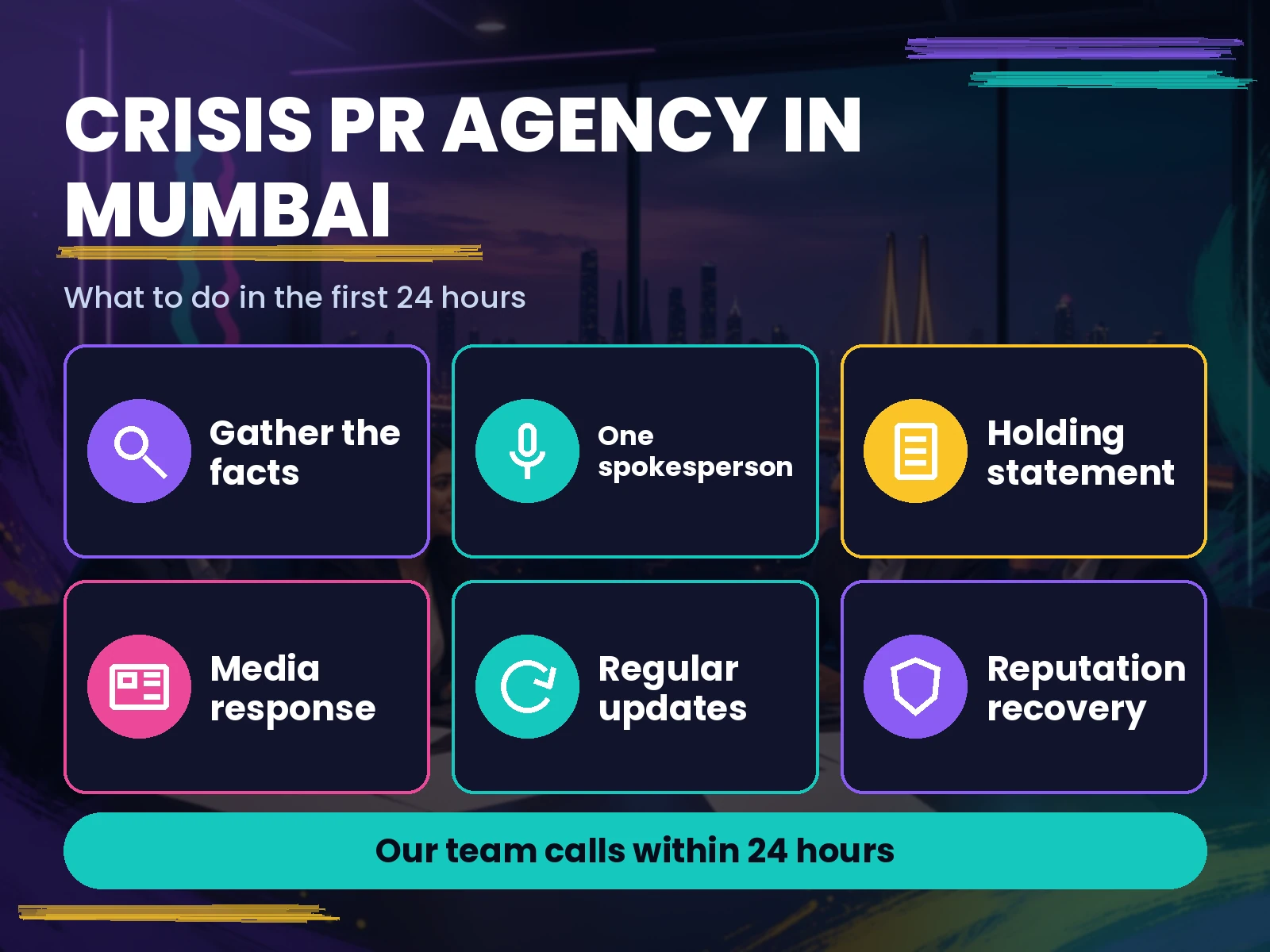
What a crisis PR agency does when something goes wrong
A crisis is any event that can damage trust quickly: an accident at a site, a product problem, a data leak, a viral complaint, a staff issue or a legal notice that reaches the media. In Mumbai, where news desks, social media and messaging groups move fast, a story can travel across the city before the management meeting has started.
Crisis PR does not hide the problem or make it look smaller than it is. Its job is to make sure the public, your customers and your staff get accurate information from you, quickly and in one voice, and that every promise you make is one you can keep. Silence lets others tell the story; guesses create corrections later.
The first 24 hours matter most. This page sets out an hour-by-hour plan for that first day, the kinds of statement you will need, and the checks we run before anything is said in your name. It also covers what to prepare now, before anything happens.

Something going wrong right now? Talk to us.
Leave your name and number. Our team calls you back within 24 hours, listens to the facts and tells you plainly what to do first.
The first 24 hours, hour by hour
Real crises rarely run to the clock, so the order matters more than the exact hours.
Hour 0 to 1: get the facts
One person owns the crisis. They find out what happened, who is affected, what is confirmed and what is not, and write it down.
Hour 1 to 2: one spokesperson
One named person speaks for the business. Everyone else, including staff, refers questions to them.
Hour 2 to 4: holding statement
A short statement that says what you know, what you are doing and when you will update. Approved, then shared.
Hour 4 to 12: updates
Regular updates as facts are confirmed, to media, staff, customers and anyone affected, all saying the same thing.
Hour 12 to 24: review
What has been said, what people are asking, what has changed, and the plan for the days ahead.

Silence vs a holding statement vs a full statement
Three ways to respond in the first hours. Only one of them works while facts are still coming in.
| Silence or "no comment" | A holding statement | A full statement | |
|---|---|---|---|
| When it fits | Almost never | The first hours, while facts are confirmed | Once the key facts are confirmed |
| What it tells people | That you are hiding something, even if you are not | That you know, you care and you are acting | What happened, why, and what you will change |
| What it contains | Nothing | Known facts, actions taken, time of the next update | Facts, causes found so far, steps taken and commitments |
| Risk | Others fill the gap with guesses | Low, if it states only confirmed facts | High, if it is rushed before facts are checked |
| Who approves it | Nobody | The spokesperson and management, quickly | Management, and legal advisers where needed |
Crisis PR services for Mumbai businesses
Before, during and after a crisis.
Crisis readiness plan
Likely scenarios, who decides, who speaks and draft statements, prepared before anything happens.
Holding statements
Short, factual statements written and approved within hours, in English, Hindi or Marathi as needed.
Spokesperson training
Practice for hard questions, on camera and on the phone, so the spokesperson stays calm and accurate.
Media handling on the day
One point of contact for reporters, with every call logged and answered in the agreed words.
Online reputation care
Calm replies to reviews and posts, and the correct facts made easy to find in search.
Monitoring and reports
What is being said, where and by whom, collected through the day and summarised for management.
Six kinds of crisis to plan for
Each needs a different first statement. Planning for them now saves hours later.
Accidents and safety incidents
An injury at a site, a fire or a building problem. People first, then facts, then the statement.
Product or service failures
A fault, a recall or an outage. Tell customers what to do now, and when it will be fixed.
Data and privacy issues
A leak or a breach. Explain what was affected, what customers should do and what you are doing about it.
Viral complaints
A customer video or post spreading fast. Reply in public with care, then solve the problem in private.
Staff and leadership issues
A complaint against a senior person, a strike or a sudden exit. Fair to everyone, with legal advice where needed.
Legal and regulatory notices
A notice, an inspection or a court case in the news. Say only what your lawyers approve, and say it clearly.
Is your team ready for the first hour of a crisis?
Tick what your business already has in place. Your answers stay on your screen; nothing is sent or saved.
A holding statement in Hindi, line by line
Many Mumbai readers and viewers follow the news in Hindi and Marathi. This is the shape of a short holding statement in Hindi; every real one is written for the facts of the day and approved before it is shared.
- शुरुआत
आज [समय] पर [जगह] में [घटना] की जानकारी हमें मिली।
Start with what happened, plainly, without excuses. - सबसे पहले
हमारी पहली चिंता [प्रभावित लोगों] की सुरक्षा और मदद है।
People come before the business. - तथ्य
अभी तक हम इतनी पुष्टि कर सकते हैं कि [पक्की जानकारी]।
Only confirmed facts; no guesses about causes. - क़दम
हमने [उठाए गए क़दम] उठाए हैं और [संबंधित विभाग] के साथ पूरा सहयोग कर रहे हैं।
Show action, not only regret. - अगला अपडेट
हम आज [समय] तक अगली जानकारी साझा करेंगे।
A time for the next update stops speculation. - संपर्क
मीडिया के सवालों के लिए: [प्रवक्ता का नाम], [फ़ोन]
One contact, so every question reaches one voice.
Crisis statement checklist: 8 checks before anything is said
We run these on every statement, update and interview during a crisis.
- Facts confirmedEvery fact checked by the person who owns the crisis, in writing.
- No guessing about causesCauses are stated only when they are known, not when they are suspected.
- People firstThose affected are mentioned before the business, with what is being done for them.
- One voiceThe same words for media, staff, customers and social media.
- Legal review where neededStatements that touch liability or a court case are read by your lawyers first.
- Promises you can keepNo dates or commitments the business cannot meet.
- Next update timeEvery statement says when people will hear from you again.
- Privacy protectedNo names or details of affected people without their consent.
How a crisis travels in Mumbai's media
A crisis in Mumbai rarely starts on the front page. It often begins with a post, a forwarded message or a call to a city reporter, then moves to news websites, television tickers and the next morning's papers, in English, Hindi and Marathi. By the time a statement is ready, many people have already formed a view.
That is why the first holding statement must go out within hours, and why it must reach the same places the story is moving: the reporters who called, your own website and social media, your staff and anyone affected directly. One accurate statement, shared quickly in all those places, does more than a long one shared late.

Crisis PR mistakes that make things worse
Much of the damage in a crisis comes from the response, not the event.
Saying "no comment" or going silent for a day
Silence reads as guilt, and others fill the gap with guesses.
Several people speaking to the media with different stories
Two versions of events become the story itself.
Guessing the cause before it is confirmed
A wrong guess means a correction, and a second headline.
Deleting critical posts instead of answering them
Screenshots travel faster than the original post, with "they deleted it" added.
Promising a fix date the business cannot keep
A missed promise restarts the crisis a week later.
Crisis PR Agency in Mumbai: questions
How fast should we respond to a crisis?
Within the first few hours, with a holding statement, even if all you can say is what you know, what you are doing and when you will update.
What is a holding statement?
A short statement for the first hours of a crisis. It gives the confirmed facts, the action being taken and the time of the next update, without guessing causes.
Who should be our spokesperson in a crisis?
One senior person who knows the facts, stays calm under pressure and can speak in the language of the audience. Everyone else refers questions to them.
Should we reply to negative posts on social media?
Reply calmly to the main posts with the same facts as your statement, and move individual complaints to a private conversation. Deleting critical posts usually makes things worse.
Can a PR agency stop a negative story from being published?
No, and an honest agency will not promise it. We make sure reporters have your accurate side of the story, quickly, so what is published is fair and correct.
Do you work with our lawyers during a crisis?
Yes. Statements that touch liability, a court case or a regulator are reviewed by your legal advisers before they are shared.
Can you help before a crisis happens?
Yes. A readiness plan names the owner and the spokesperson, drafts statements for likely scenarios and trains the spokesperson, so the first hour is not spent deciding who does what.
Do you handle crises in Hindi and Marathi media?
Yes. We write statements and brief spokespeople in English, Hindi and Marathi, so every desk gets the same facts in its own language.
What happens after the first 24 hours?
Regular updates until the issue is resolved, a summary of what was said and published, and a review of what to change so it does not happen again.
More PR help from TTS Digital
The services around crisis work, and the sectors where it matters most.
Best PR agency in Mumbai
All twelve PR services in one place, and the checks to run on any agency.
Read more →Top PR agency in Mumbai
Who TTS Digital is, the promises we keep and how a campaign runs.
Read more →Financial PR
Precise, compliance-cleared communication for regulated firms.
Read more →Healthcare PR
Careful, doctor-approved stories for hospitals and clinics.
Read more →Want a plan in place before you need it?
Fill in the form or message us on WhatsApp. We call you back within 24 hours and send a written scope for a crisis readiness plan.